
Board, straps and kite choices for waves
In short
Wave kiting rewards a smaller kite, a surf-style directional board, and a stance that lets the wave do the work.
Trim your kite so it flies clean when the bar is sheeted right in, and unhooking to surf becomes far easier.
What you'll learn here
How to choose a board, whether to run straps, why riders unhook, and how to size your kite for the surf.
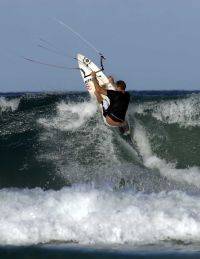
The gear that works in flat water is not the gear that works in the surf, and that trips up a lot of good riders.
Everything about waveriding pushes you toward less: less board, less kite, less power, and a stance closer to plain surfing.
Start with a proper surfboard. A directional surf-style board, not a twin tip, is what lets you draw a real line on a wave face.
Choosing a board
Epoxy or polyester is the first call. Epoxy is lighter and tougher, so it shrugs off the small knocks, while polyester flexes and sits in the water for a smoother feel through chop.
Epoxy is also more buoyant, which can feel a touch bouncy in chop, but it tends to last longer and take more abuse.
For most newcomers an epoxy board shaped by a surf shaper is the better value, because it survives the learning curve and still rides well.
Either construction will break under real force, so treat a poly board with extra care if you go that way.
On a budget, ride what you already surf. A basic used surfboard can get you into kite waveriding cheaply, and you can pick one up for very little.
What size board
Many riders use the same length they surf. That keeps the quiver small and lets you surf in the morning and kite the same board in the afternoon.
A smaller board demands more fitness and cleaner technique, so it is not the easy option when you are starting out.
A common rule of thumb is a board a couple of inches taller than you, so a rider around six foot might ride roughly a 6'2.
If you carry more weight, add a little length or volume rather than fighting a board that sits too low.
"Being hooked in pivots you at the waist, but unhooked you get a fully open stance and surf the wave the way you would without a kite."
Straps or strapless

Straps are a personal choice, not a rule. Some riders go strapless from their very first wave sessions, so it is clearly possible to learn without them.
Most people feel steadier in straps at first and then progress to strapless once the basics settle.
Straps still earn their place in strong, bumpy conditions above about 30 knots, where they help you stay locked to the board.
They also let you experiment with small airs, and you can carry those moves across to strapless riding later.
Why riders unhook
Unhooking frees your stance. Riding hooked in pivots you at the waist where the harness sits, which fights a natural surfing posture.
Unhooked, you open up and can drive off the wave rather than off the kite, using the wave's energy to power the ride.
If you cannot hold the power unhooked, look at your trim first. Most riders who struggle simply have the kite trimmed wrong for unhooked riding.
Set the kite so it sits in its optimal position when the bar is pulled all the way down to the chicken loop.
Then when you unhook the kite keeps flying cleanly instead of stalling or flying backwards.
If it does stall or drift back, the kite is oversheeted, so pull on the depower strap until it flies right with the bar fully in.
Sizing your kite for the surf

Your freestyle kite will work in waves. You just rarely need as much power, because the bigger board carries you and you only want enough drive to move around the surf.
Too much kite is one of the most common mistakes in the waves, so err on the smaller side.
A smaller kite turns faster and lets you kill the power quickly when you are riding down a wave.
Many riders cover a wide wind range with just two sizes, stepping down a size once the wind climbs enough that unhooking gets a handful.
Before you head out, check the wind forecast so your session lands on a size you can actually handle.
Questions & Answers
Do I need a wave-specific kite? Not to start. A standard freestyle kite works fine in the surf, and you will usually run it smaller than you would for flat water. Dedicated wave kites turn faster and drift better, but they are a refinement, not a requirement.
Should I learn strapless straight away? You can, and some riders do, but most find it easier to build board control in straps first. Once you can ride upwind and turn confidently, dropping the straps is a natural next step rather than a leap.
Why do I keep getting pulled off my board when I unhook? Almost always trim. If the kite stalls or flies backwards when you unhook, it is oversheeted. Add depower until the kite flies cleanly with the bar sheeted fully in, then try again.
Can I use the same board for surfing and kiting? Yes, and many riders do exactly that to travel light. A board around a couple of inches over your height works for both, though a smaller board asks for more fitness and cleaner technique.